

Word puzzles have a reputation problem. Most people picture crosswords or word searches and assume they've seen everything the genre has to offer. They haven't. The universe of unique word puzzle challenge types stretches far beyond those familiar grids, into territory that tests visual thinking, strategic guessing, sequential logic, and cultural pattern recognition all at once. If you've been solving the same formats on repeat, this breakdown will change what you reach for next. Here are the most compelling and cognitively distinct puzzle types available to serious enthusiasts right now.
Table of Contents
- Key takeaways
- Unique word puzzle challenge types: how to evaluate them
- 1. Rebus and image-compound puzzles
- 2. Multi-word simultaneous guessing puzzles
- 3. Word chain and linked phrase puzzles
- 4. Hybrid category grouping puzzles
- 5. Spelling Bee and compound vowel loop puzzles
- 6. Cryptic crosswords and indirect clue puzzles
- My take on what makes these formats worth your time
- Try a word puzzle experience built for enthusiasts
- FAQ
Key takeaways
| Point | Details |
|---|---|
| Puzzle DNA shapes your experience | Word puzzles divide into clue-based, letter-based, and structural-based types, each demanding different cognitive skills. |
| Visual-linguistic puzzles are underrated | Rebus and image-compound puzzles challenge associative thinking in ways standard word games never do. |
| Multi-word guessing multiplies strategy | Solving four words simultaneously forces you to think about every guess as a multi-variable decision. |
| Grouping puzzles test more than vocabulary | Category puzzles like Connections reward cultural knowledge and pattern recognition over raw word recall. |
| Gamification drives deeper engagement | Timers, leaderboards, and progression systems turn passive recognition into active, retention-building recall. |
Unique word puzzle challenge types: how to evaluate them
Before you can appreciate what makes a puzzle format genuinely fresh, you need a framework for comparing them. Not all creative word puzzles are built the same, and understanding their underlying structure tells you a lot about what kind of thinker they reward.
According to puzzle type taxonomy, word puzzles divide into three core DNA categories:
- Clue-based puzzles give you indirect hints and ask you to deduce the target word. Crosswords and cryptics live here.
- Letter-based puzzles provide the raw letters and ask you to construct or identify words. Anagrams, Wordle, and Spelling Bee belong in this group.
- Structural-based puzzles focus on how words connect, sequence, or relate to each other. Word chains and compound-word builders fall into this category.
Beyond DNA type, the best word puzzle variations share a few qualities worth measuring: a meaningful difficulty curve that doesn't spike too fast, cognitive variety so each session exercises different mental muscles, and enough novelty that the format doesn't feel like a reskin of something you've already mastered.
Gamification elements like timers, leaderboards, and leveling systems significantly boost vocabulary retention and active engagement. The reason is simple. Active retrieval driven by game design outperforms passive recognition, which means a well-designed puzzle teaches you more than a flashcard ever will.
Pro Tip: When evaluating a new puzzle format, ask yourself which of the three DNA types it belongs to. If it blends two or more, that's usually a sign the format has genuine depth.
1. Rebus and image-compound puzzles
Rebus puzzles are one of the most underappreciated formats in the word game world. The mechanic is deceptively simple: you see two images placed side by side, and your job is to combine them into a single compound word. A picture of a sun next to a picture of a flower becomes "sunflower." Sounds easy until the images get abstract.
The cognitive challenge here is real. Rebus puzzles require players to synthesize two images into compound words through high-level associative thinking, with expert-level solvers typically clearing 13 out of 15 levels before hitting their ceiling. That gap between beginner and expert performance tells you something important: this format has a genuine skill ceiling, not just a difficulty spike.
What makes rebus formats stand out among fun word games is that they activate visual processing and linguistic reasoning at the same time. Most word puzzles run entirely through language. Rebuses force your brain to translate image into concept into word, which is a fundamentally different cognitive path.
Visual thinkers who struggle with traditional crosswords often thrive here. And for solvers who already dominate letter-based formats, rebuses offer a refreshing left turn. Compound word puzzles reward solvers who think in roots and word families rather than isolated words, which builds morphological fluency over time.
2. Multi-word simultaneous guessing puzzles
If standard Wordle feels too contained, multi-word guessing formats are the logical next step. These are some of the most demanding challenging word games available, and the mechanics explain why.
Quordle requires players to solve four five-letter words simultaneously using only nine guesses, with a color-coded hint system that applies each guess to all four grids at once. Every letter you choose has to do four jobs at the same time. That constraint transforms a vocabulary exercise into a resource management problem.
Here's what makes the strategic layer so interesting:
- Opening guesses are investments. Your first two guesses should maximize letter coverage across all four grids, not chase any single word.
- Color feedback compounds. A yellow letter in grid one and a green letter in grid three from the same guess gives you two data points from one move. Reading that compound feedback quickly is the core skill.
- Sacrifice plays exist. Sometimes you burn a guess entirely on information gathering, accepting no progress on any word in exchange for eliminating a cluster of letters.
- Grid priority shifts. As the game progresses, you'll naturally focus on the grids with the fewest remaining possibilities. Knowing when to shift focus is what separates good solvers from great ones.
The daily puzzle culture around these formats adds another layer. Players share their colored result grids without spoilers, creating a social ritual that keeps engagement high without giving anything away.
3. Word chain and linked phrase puzzles
Word chains are structural-based puzzles at their purest. The basic version asks you to move from one word to another by changing a single letter at a time, with every intermediate step forming a valid word. CAT becomes DOG through CAT, COT, COD, COG, DOG. Four steps. Each one a real word.
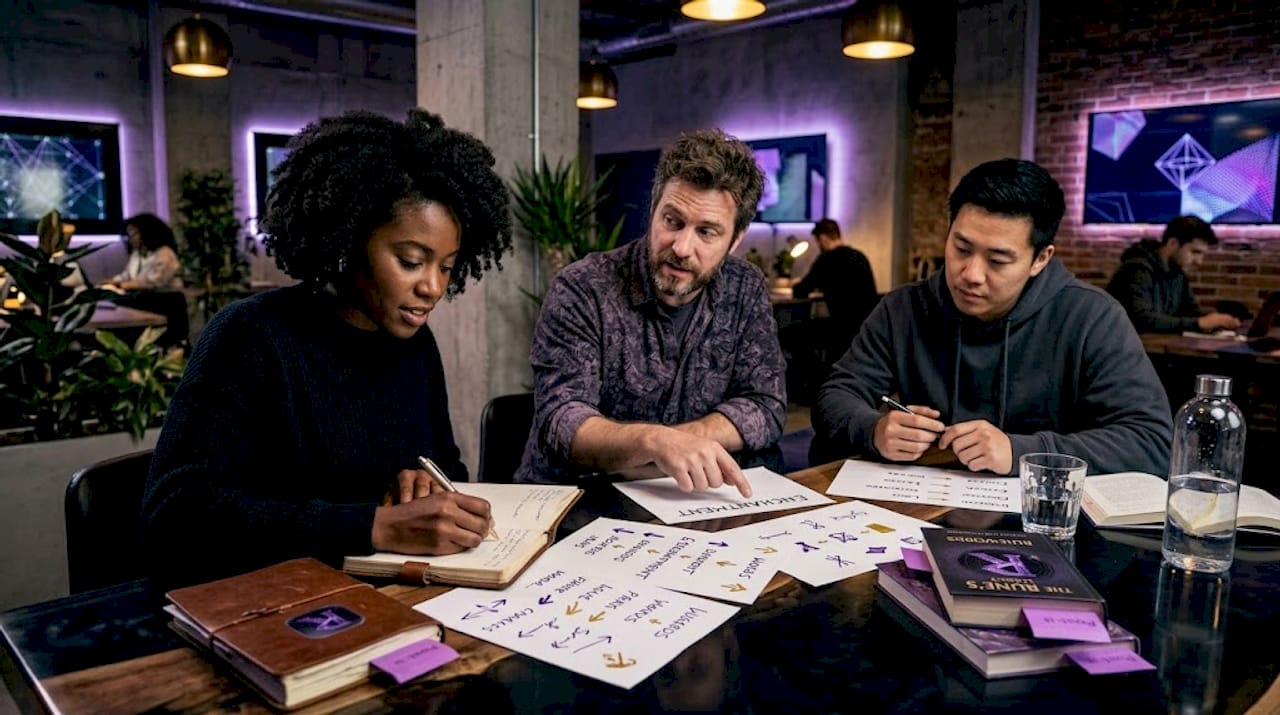
The more complex versions introduce compound word linking, where the last syllable or word of one phrase becomes the first of the next. "Sunflower" links to "flower pot" links to "pothole" links to "holdup." The chain keeps moving, and your job is to find or complete the sequence.
What these puzzles build:
- Sequential logic. You can't jump ahead. Every step must be valid before you move to the next.
- Lexical flexibility. You need to hold multiple possible paths in mind and evaluate which ones lead somewhere useful.
- Pattern recognition. Experienced solvers start to see common "bridge words" that connect otherwise distant vocabulary clusters.
Block-ordering variants add a spatial element, presenting word fragments out of sequence that must be arranged into a coherent chain. These are particularly good at exposing gaps in your sense of how compound words actually assemble.
Pro Tip: When you're stuck on a word chain, work backward from the target word. Sometimes the reverse path is more obvious than the forward one, and it gives you a middle anchor to build toward from both ends.
4. Hybrid category grouping puzzles
Category grouping puzzles like NYT Connections represent something genuinely new in the word puzzle space. The format gives you 16 words and asks you to sort them into four groups of four, with each group sharing a hidden theme. The catch is that the themes are rarely obvious, and the puzzle is deliberately seeded with words that look like they belong together but don't.
Modern hybrid puzzles focus less on pure vocabulary and more on categorization and linguistic pattern recognition to engage players deeply. That shift matters. You don't win by knowing more words. You win by seeing how words relate to each other in unexpected ways.
The red herring problem is where most players stumble. Grouping 16 words into four categories requires strategic tentative sorting to avoid errors, because words that fit multiple categories are the most common failure point. Short, common words are especially dangerous. Deliberate placement of simple words skews players toward abstract but correct categories, which is a design choice, not an accident.
Here's a quick comparison of how grouping puzzles stack up against other interactive word challenges:
| Feature | Grouping puzzles | Letter-based puzzles |
|---|---|---|
| Core skill tested | Categorization and pattern recognition | Vocabulary and letter logic |
| Cultural knowledge required | High | Low |
| Red herring risk | High | None |
| Replay variability | High | Moderate |
| Difficulty source | Misdirection | Word complexity |
The expert strategy is to lay out all 16 words mentally and sort them into tentative groups before committing to any single answer. Sorting all words first to identify red herrings and avoid category conflicts is the approach experienced solvers rely on to avoid early mistakes that cascade into failed boards.
5. Spelling Bee and compound vowel loop puzzles
The NYT Spelling Bee looks simple on the surface: one center letter, six surrounding letters, make as many words as you can using the center letter every time. The actual depth of the format only reveals itself once you start chasing the "Genius" or "Queen Bee" ratings.
2026 Spelling Bee themes emphasize compound constructions and repeated vowel loops, rewarding pattern recognition and root-word thinking. A single puzzle can contain 48 valid words, multiple pangrams, and a point ceiling that takes genuine morphological fluency to reach.
The skill this format builds most directly is word family awareness. Solvers who think in roots and affixes rather than isolated words consistently outperform those who rely on brute-force recall. Recognizing that "compound" and "compounding" and "compounder" all count is the difference between a good score and a great one.
6. Cryptic crosswords and indirect clue puzzles
Cryptic crosswords operate on a completely different logic from standard crosswords. Every clue contains two parts: a straight definition of the answer and a wordplay component that arrives at the same answer through a different route. Your job is to recognize which part is which, and then solve both.
The wordplay mechanisms include anagrams (signal words like "broken" or "mixed" tell you the letters are scrambled), hidden words (the answer is buried inside the clue itself), reversals, and letter deletions. A clue like "Confused ranter is a storyteller (8)" tells you the answer is an 8-letter word that means "storyteller" and is an anagram of "ranter" plus something else. The answer is "narrator."
What makes cryptics one of the best word puzzle types for experienced solvers is that they reward meta-thinking. You're not just solving a puzzle. You're decoding the puzzle designer's logic, which adds an entirely different layer of satisfaction to the solve.
My take on what makes these formats worth your time
I've spent a lot of time with word puzzles across formats, and the thing that consistently surprises me is how differently each type taxes the brain. Solving a rebus and solving a cryptic crossword feel almost nothing alike, even though both technically involve words.
What I've found is that solvers who stick to one format plateau faster than those who rotate. The cognitive skills don't transfer automatically. Getting good at Quordle's multi-grid logic doesn't make you better at Connections' categorization traps. Each format is its own discipline.
The pitfall I see most often is treating difficulty as the only metric for a good puzzle. Some of the most rewarding formats aren't the hardest ones. They're the ones that make you think in a way you haven't before. Rebus puzzles are a good example. They're not brutally hard, but they activate a part of your brain that most word games never touch.
My honest recommendation: pick one format from each DNA category and give it a serious month. Clue-based, letter-based, structural-based. You'll come back to your favorites with sharper instincts and a much clearer sense of what kind of solver you actually are.
— Anthony
Try a word puzzle experience built for enthusiasts
If you've worked through this list and want a format that combines the best of swipe-based letter play with handcrafted board design, Runewords is worth your time.
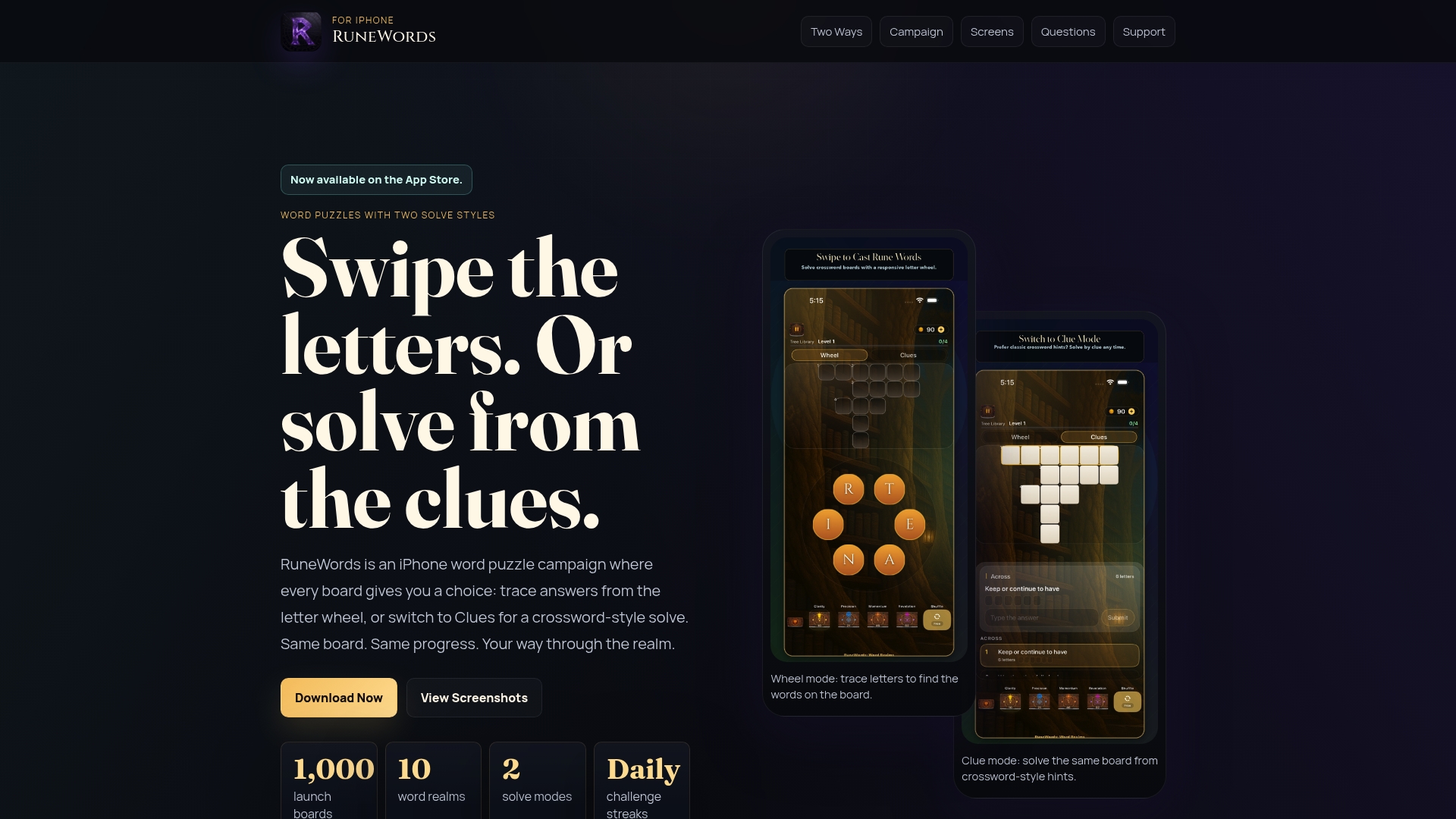
Runewords is a mobile word puzzle game built around two distinct solving styles on a single platform. With 1,000 handcrafted boards across ten themed worlds and a fresh daily challenge every day, it gives puzzle enthusiasts the kind of depth and variety this article has been describing. The progression system, with runes, coins, and unlockable content, keeps each session feeling earned rather than arbitrary. If you're ready to try word puzzles done differently, Runewords is available now on iPhone.
FAQ
What are the main types of unique word puzzle challenges?
Word puzzles divide into clue-based, letter-based, and structural-based formats. The most distinct challenge types include rebus image puzzles, multi-word guessing games, word chains, category grouping puzzles, and cryptic crosswords.
How does Quordle differ from standard Wordle?
Quordle requires solving four five-letter words simultaneously in nine guesses, applying each guess to all four grids at once. This forces players to treat every guess as a strategic multi-variable decision rather than a single-word pursuit.
Why are category grouping puzzles harder than they look?
The difficulty comes from deliberate misdirection. Red herrings in grouping puzzles place words that appear to belong together in different categories, making confident early guesses the most common path to failure.
What cognitive skills do rebus puzzles build?
Rebus puzzles develop associative thinking and morphological fluency by requiring players to translate visual images into compound words. They activate visual processing and linguistic reasoning simultaneously, which most letter-based formats never do.
How do gamification elements improve word puzzle engagement?
Gamification in word challenges like timers, leaderboards, and leveling systems convert passive word recognition into active recall, which research shows produces significantly better vocabulary retention than recognition-only formats.